To qualify for the EB-5 visa, you'll need to invest a minimum of $800,000 in a targeted employment area or $1,050,000 in other locations, while ensuring your capital creates or maintains at least 10 full-time U.S. jobs. This route presents you and your family a path toward permanent residency, but navigating the intricate regulations, job creation rules, and paperwork requirements proves complex. Professional EB-5 attorneys can enhance your plan, secure your investment, and address legal challenges—here's how to optimize favorable outcomes along the way.
Essential Insights
To qualify for an EB-5 visa, you need a minimum investment of $1,050,000, or $800,000 when investing in a Targeted Employment Area, into a new or substantially reformed U.S. business enterprise. Applicants must generate or sustain a minimum of 10 full-time employment opportunities for eligible U.S. workers as part of the investment qualifications. The investment opportunity allows program participants, their husband or wife, and single children under twenty-one to acquire a U.S. green card and possible citizenship. The procedure commences with Form I-526, followed by adjustment of status or consular processing options once the petition is approved. Expert EB-5 lawyers assist clients through the complete process of choosing investments, paperwork, regulatory requirements, and each step of the immigration process.The EB-5 Visa Program: A Historical Overview and Purpose
While the U.S. government has long sought ways to boost domestic economic growth, Congress implemented the EB-5 Immigrant Investor Program in 1990 as a key program to directly stimulate the American economy through international investment and employment generation. The program's development demonstrates its evolution from an entrepreneur's visa to an investor's visa, structured to secure international investment into commercial projects.
Congress strengthened the program's investment framework by creating the Immigrant Investor Pilot Program (commonly called) the Regional Center Program, which permitted investors to count both direct and indirect jobs toward the mandatory 10-job creation threshold. This enhancement made the program more attractive by facilitating passive investments through pre-approved regional centers, significantly boosting participation rates after 2005 when USCIS implemented reforms to improve the application process.
Comparing TEA and Standard Investment Requirements
The EB-5 investment program has developed from its early beginnings to include varied investment thresholds designed for various economic areas. As an investor, you should be familiar with the two capital deployment options at your disposal.
The basic investment threshold currently stands at $1,050,000 for ventures outside specified zones. Yet, if you invest in a TEA—comprising high-unemployment regions or rural locations—you can take advantage of a decreased requirement of $800,000.
Regardless of which investment threshold applies to your situation, you have to verify your capital creates at least 10 full-time employment opportunities for qualifying U.S. workers. These varying investment requirements reflect the program's aim to boost economic growth in areas that need it most while providing investors a path to permanent residency.
Job Creation Requirements: Meeting the 10-Job Threshold
As an EB-5 investor, you'll need to establish or maintain a minimum of 10 full-time jobs for eligible U.S. workers in two years of becoming a Conditional Permanent Resident. While direct investments require you to create employer-employee relationships with your enterprise as the direct employer, regional center investments offer greater flexibility by permitting up to 90% of your job creation requirement to be satisfied through indirect jobs generated as a result of your investment. When looking into investing in a troubled business, you can meet requirements through job maintenance rather than new job creation, assuming you maintain existing employment at pre-investment levels for no less than two years.
Direct & Indirect Employment
Meeting the job creation prerequisite lies at the core of a successful EB-5 visa application, with different pathways available depending on your investment structure. When you opt for a direct investment, you must show direct job creation—your business has to employ at least 10 full-time U.S. workers directly, forming an employer-employee relationship within your new commercial enterprise. In contrast, if you invest through a regional center, the rules allow you to count both direct and indirect job creation. Indirect jobs are those generated as a result of the project’s economic activity, such as jobs at suppliers or service providers, extending your options for satisfying the 10-job threshold with greater flexibility.
Regional Center Benefits
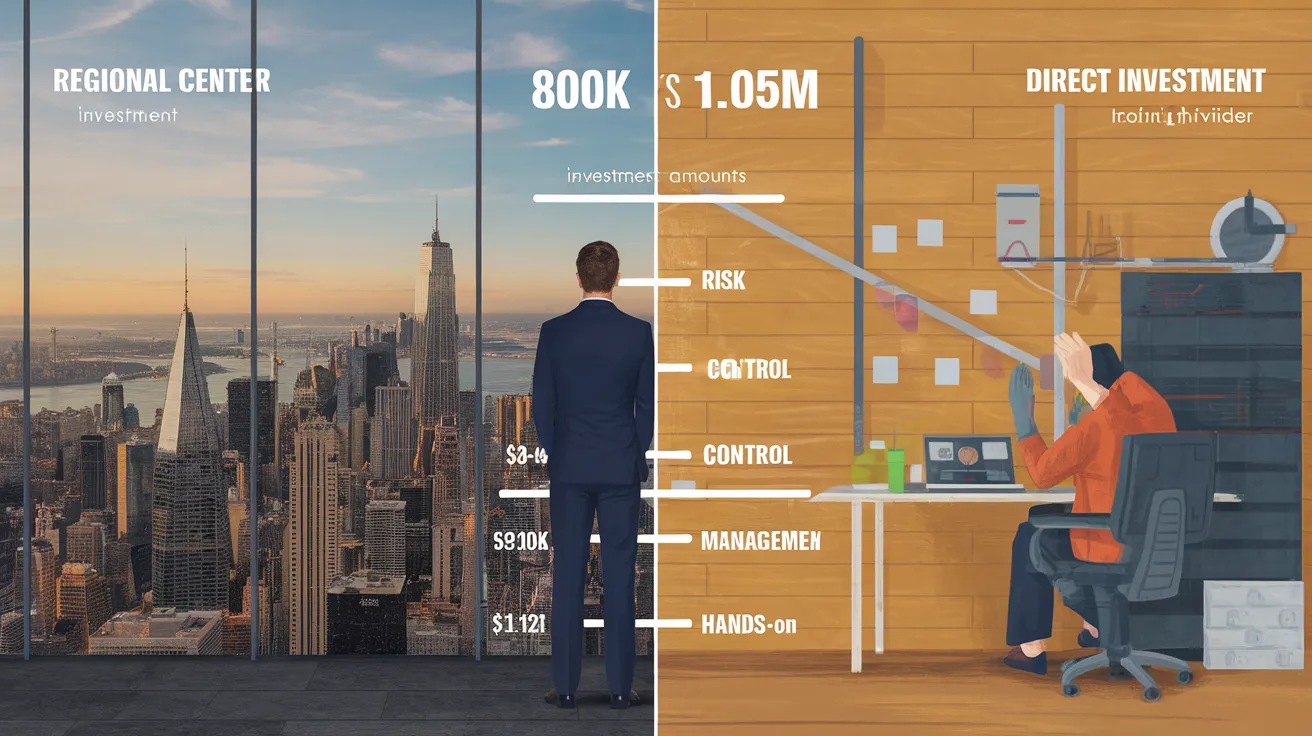
Choosing a regional center offers a simplified route to meet the EB-5 program's 10-job criteria, delivering flexibility that's notably valuable for investors who prefer a hands-off approach. This investment route enables you to include various forms of job creation, significantly expanding your potential to comply with USCIS criteria.
One of the main benefits of the regional center program is the limited management responsibility. You won't need to manage routine business operations, allowing you to continue unrelated employment while obtaining your green card.
Numerous regional center projects are located in targeted employment areas (TEAs), qualifying for the lower $800,000 investment threshold as opposed to the standard $1.1 million requirement. Additionally, exemplar approvals deliver added security—when you place your investment in a pre-approved project, the majority of your I-526 petition is already cleared, necessitating only your source of funds documentation for review.
Job Maintenance Options
While many investors concentrate on creating ten jobs, maintaining those positions throughout the required investment period is equally important for EB-5 compliance. When investing in a troubled business, you must prove that existing jobs were maintained—this is where job retention strategies become essential. Tracking employee status, retaining qualified U.S. workers, and ensuring positions remain full-time are all essential actions. Employment verification should be systematically tracked and verified to demonstrate that jobs were preserved during the investment window. Strategic implementation of a job buffer—establishing more than the minimum ten jobs—can offer protection against unanticipated reductions, lowering risk and bolstering your position for meeting EB-5 requirements.
Understanding the Application Process: From I-526 Petition to Conditional Green Card
The EB-5 process starts with filing Form I-526, which presently requires between 71.1 months to process, although rural projects can receive expedited approvals in as little as 11 months. You will then move forward through either status adjustment (if you're in the U.S.) taking 6-8 months, or consular processing (if outside the U.S.) involving DS-260 filing with an interview usually scheduled within 60-90 days after USCIS approval. Finally, you must file Form I-829 to eliminate the conditions on your permanent resident status, a process that typically takes 22-48.5 months but ultimately allows you and your family to permanently reside in the United States.
Steps to File I-526 Petition
The procedure begins when you submit and file Form I-526, the Immigrant Petition by Alien Investor, with U.S. Citizenship and Immigration Services (USCIS). Your petition must verify eligibility and establish your significant investment in a eligible U.S. business.
To prepare your I-526 checklist, assemble documentation that proves your investment source, detailed business strategy, and workforce development estimates. Select either investing directly or through a regional center based on your investment objectives.
Present petition processing timelines differ considerably, with USCIS primarily processing petitions lodged prior to March 15, 2022. After receiving approval, you'll need to continue with filing Form DS-260 for your immigrant visa registration.
The petition acts as a formal document showcasing conformity with EB-5 standards and investment commitment. Although the process may take time, careful preparation confirms your submission meets all requirements for moving forward in pursuit of permanent residency.
Adjustment of Status vs. Consular Processing
Following the approval of your I-526 petition, you must select between two different routes to secure your EB-5 conditional green card: consular processing or adjustment of status. Your immigration status and present location upon receiving approval will establish your ideal route.
Consular processing is required if you're outside the United States, requiring completing the necessary DS-260 paperwork and civil documents to the National Visa Center, followed by a mandatory interview at an American consulate.
Adjustment of status is only available when you're legally present in the U.S. Although this route generally provides a faster timeline and allows you to travel and work during processing with Employment Authorization and Advance Parole documents, not all individuals meet the requirements for this pathway.
Each immigration track leads ultimately permanent residence status but has substantial differences in timeline and documentation needs.
Eliminating Residency Conditions
After your petition receives approval and you 've navigated consular processing or status adjustment, you will receive a conditional green card lasting two years. To lift the conditions on your permanent residency, you need to file Form I-829 within the 90-day period before your card expires. You will need to demonstrate you've fulfilled all residency requirements: kept up your investment and confirmed your business created or is expected to create at least 10 full-time jobs. Meeting these conditions is critical. Failing to submit your I-829 petition by the deadline may lead to the removal of your permanent resident status. On-time, precise filing, accompanied by thorough documentation, is vital for successfully removing conditions and maintaining long-term residency benefits.
Removing Conditions: Your Path to Permanent Residence
Upon nearing the end of your two-year conditional permanent resident status, based on your EB-5 investment, it's necessary to go through the critical process of removing these conditions to secure your permanent Green Card.
As a conditional status investor, your primary duty is completing Form I-829 (Petition by Entrepreneur to Remove Conditions) within the 90-day period immediately before the two-year mark of obtaining your conditional Green Card. This filing must prove that you've sustained your investment during the required period and that your business venture has established, or will generate within a reasonable period, at least 10 full-time positions for qualified staff.
Your legal counsel will compile documentation supporting these requirements. Frequent obstacles involve keeping accurate investment records and handling accounting issues that may reveal your capital balance below the minimum required amount.
Important Considerations and Potential Issues in EB-5
The EB-5 visa process involves various crucial hurdles that investors must navigate carefully to achieve success. Processing slowdowns frequently occur, resulting from visa backlogs and longer processing times, which can affect your immigration timeline. Investment challenges persist; not performing thorough due diligence on projects may jeopardize your capital and visa eligibility. Documentation issues, especially with source of funds, often lead to requests for evidence or denials if not carefully documented. Regional center selection calls for thorough evaluation—making an incorrect choice leads to compliance challenges and financial transparency concerns. Additionally, economic fluctuations can affect job creation requirements, while evolving program rules might modify program expectations and eb5 green card eligibility. Anticipate these pitfalls to safeguard your EB-5 investment and immigration success.
Legal Expertise: A Cornerstone of EB-5 Success
Professional legal counsel guides your EB-5 journey at each phase, helping you avoid critical missteps that may result in significant setbacks or rejections. Legal professionals offer invaluable support throughout the visa process, from explaining funding prerequisites and job creation mandates to ensuring compliance with USCIS regulations.
Your attorney will guide you through due diligence when assessing potential investment projects, through either direct investments or Regional Centers. They will guide you through the complexities of visa adjudication and resolve any legal issues that emerge throughout your application.
Though not required by law, professional legal counsel is vital for a successful outcome. An experienced EB-5 attorney works closely with government officials, project developers, and regional centers to establish a comprehensive legal strategy. Considering the major financial and personal commitment involved, expert legal direction from knowledgeable professionals maximizes your chances of achieving permanent residence status.
Questions & Answers
Is it Possible for Family Members to Interview for Visas in Separate Countries
You can schedule family visa interview locations separately if family members live in different countries. Each applicant usually conducts their interview at the nearest U.S. Embassy or Consulate to their residence. Contact the U.S. Embassy or Consulate directly to coordinate interviews in different locations. This arrangement accommodates families living in different countries throughout the visa process.
Is Business Experience or English Proficiency Required for Investors?
Curious about whether you need business experience or English proficiency for an EB-5 visa application? You'll be relieved to discover you don't need specific requirements for business experience, educational background, or language skills when pursuing an EB-5 investor visa. Your application won't take longer to process based on absence of business experience. You simply need to satisfy the investment requirements and show you'll take part in business management.
Do I Need to Live Where My EB-5 Project Is Located?
You are not required to live where your EB-5 project is located. The EB-5 visa program doesn't impose any residency requirements tying you to your project location. Once your I-526E petition is approved and you receive your conditional green card, you're free to reside in any area in the United States. Your investment must remain at risk for at least 24 months, but your place of residence is not limited to the project's regional area.
How Are Our Investments While in Escrow?
Your investment funds placed in escrow receive multiple safeguards. Escrow accounts serve as a crucial financial safeguard, specifically for major EB-5 investments. You'll gain FDIC insurance through Insured Cash Sweep (ICS), which completely safeguards your $800,000 investment instead of just $250,000 without ICS. The escrow arrangement guarantees your funds will be accessible when your I-526 petition is granted or refunded if rejected, offering investment protection through this binding contract with a third-party escrow agent.
Am I Allowed to Travel Internationally After Obtaining My Green Card?
Once you have your green card in hand, you can travel abroad freely. As a lawful permanent resident, you are permitted to leave the United States, but your stays abroad should not be permanent. For absences under one year, no extra paperwork is required. However, if you anticipate being away for more than 12 months, you should request a reentry permit (Form I-131) before your trip. Extended trips over six months might impact your residency status.
Wrapping Up
Maneuvering through the EB-5 process isn't just about numbers—it's an endeavor where each element is crucial. You'll must satisfy specific investment thresholds, verify lawful funding, and guarantee job creation, all while navigating a complex application procedure. Think of an experienced EB-5 attorney as your guide: they go beyond guiding, they work to prevent challenges, translating complex requirements into practical steps on your path to permanent residency. Your green card goal calls for precision; partner with an expert.